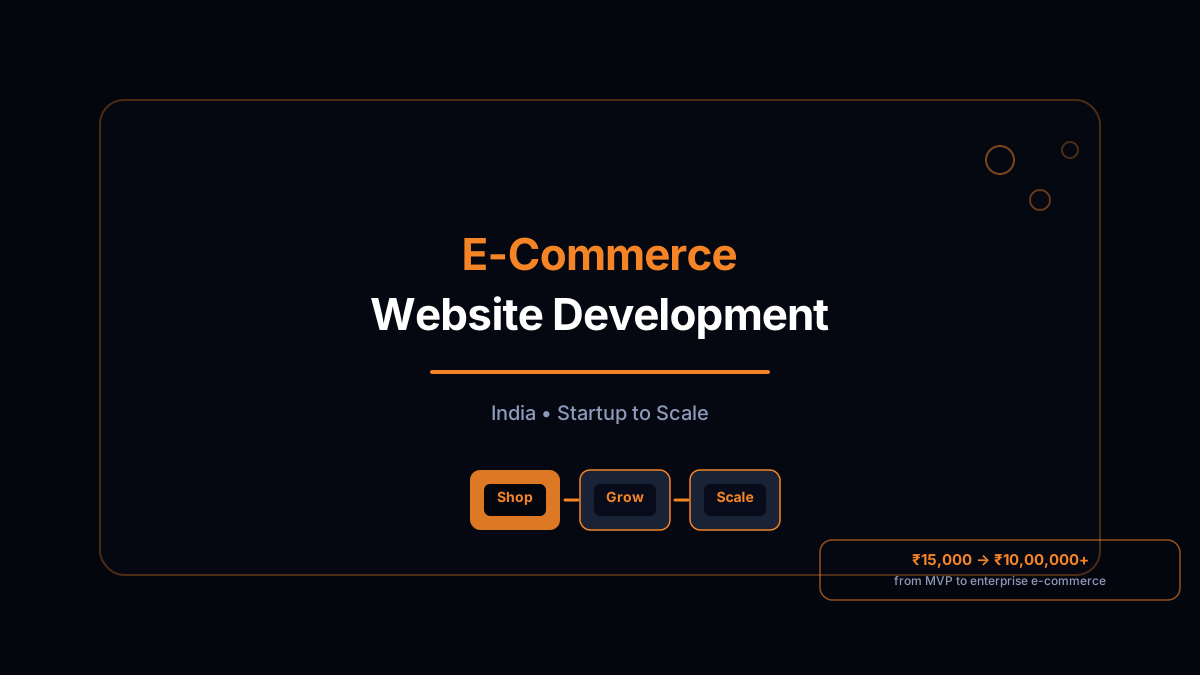
Starting an ecommerce store in India is more accessible than ever. With UPI, affordable hosting, and growing digital adoption, entrepreneurs can go from idea to online store quickly. But scaling from a startup to a sustainable, profitable business requires more than just listing products - it demands a strategic approach to website development, user experience, payments, logistics, and growth.
This guide walks you through the complete journey of ecommerce website development in India: from choosing the right platform at startup stage to scaling for enterprise growth, with practical advice on costs, compliance, SEO, and technology.
Key Insight
In India, mobile traffic dominates (often seventy percent plus), UPI is the preferred payment method, and COD still drives significant volume in many categories. Your ecommerce strategy must be built for these realities from day one.
Stage : Startup (MVP) - Validate Your Idea
At the startup stage, your goal is validation, not perfection. You need to test demand quickly with minimal investment while building a foundation that won't require a complete rebuild when you scale.
Platform Selection for Startups
| Platform | Best For | Setup Time | Monthly Cost (India) | Pros | Cons |
|---|---|---|---|---|---|
| Shopify | Quick launch, no technical team | one to three days | Rs. one thousand four hundred ninety nine - Rs. seven thousand four hundred forty seven/month | Managed hosting, easy setup, great app ecosystem, handles security | Platform fees + transaction fees, less control, apps add up |
| WooCommerce (WordPress) | Customization on a budget, content-heavy stores | one to three days | Rs. plugin + Rs. three thousand-Rs. eight thousand/month hosting | Free core, full control, vast plugin ecosystem, great for SEO | Requires maintenance, security management, hosting responsibility |
| D2C platforms (like Dukaan, Shopify India alternatives) | Hyper-quick launch with minimal setup | Few hours | Often commission-based or low subscription | Very fast, India-focused features, lower barrier | Less customizable, platform dependency, may have transaction limits |
Must-Have Features for MVP
- Product catalog with clear images, descriptions, and pricing
- Cart and checkout optimized for mobile
- Indian payment gateways (Razorpay, PayU, Cashfree) supporting UPI, cards, wallets, and net banking
- COD support where applicable for your category
- Shipping configuration for pan-India delivery
- Basic SEO (meta titles, descriptions, product URLs)
- Mobile-responsive design (non-negotiable in India)
Startup Budget Estimate (India)
| Item | Range (INR) | Notes |
|---|---|---|
| Platform/Setup | Rs. - Rs. fifteen thousand | DIY vs agency |
| Domain & SSL | Rs. one thousand - Rs. two thousand/year | Often included |
| Theme/Design | Rs. - Rs. ten thousand | Free themes often sufficient |
| Plugins/Apps | Rs. - Rs. five thousand/month | Start minimal |
| Payment Gateway Setup | Rs. (mostly commission-based) | Razorpay/PayU have no setup fees |
| Initial Inventory/Photos | Rs. two thousand - Rs. ten thousand | Varies by product type |
Total MVP investment: Rs. fifteen thousand - Rs. , is realistic for a lean startup in India.
Stage : Growth (Scale Beyond MVP) - Optimize for Conversions
Once you have traction (consistent orders), focus shifts from "can we sell?" to "how do we sell more efficiently?" This is where proper ecommerce website development pays dividends.
UX/UI Improvements That Drive Sales
- Mobile-first optimization: Test on low-bandwidth networks, optimize images (WebP), minimize JS. Most Indian users browse on 4G/3G.
- Faster checkout: Reduce form fields, offer guest checkout, save addresses, integrate one-click payments (UPI intent flows)
- Product discovery: Implement smart search, filters by price/category/brand, and product recommendations
- Trust elements: Display secure payment badges, return policy, customer reviews with photos, and GST/invoice clarity
- Personalization: Recently viewed, "frequently bought together", and category-based recommendations
Technical Upgrades for Growth
| Upgrade | Impact | Priority | Notes |
|---|---|---|---|
| Performance optimization | High (SEO + conversions) | P0 | CDN, caching, image optimization, lazy loading |
| Advanced SEO | High (organic growth) | P0 | Product schema, breadcrumb schema, FAQ schema, clean URLs |
| Inventory management | High (operations) | P0 | Sync with warehouse, prevent overselling, low-stock alerts |
| Order management & tracking | High (CX) | P0 | Integrate with shipping partners (Delhivery, BlueDart, Shiprocket, Ecom Express) |
| Analytics & tracking | High (data-driven) | P0 | GA4, Meta Pixel, Google Search Console, conversion tracking |
GST, Compliance & Payments for Scale
- GST compliance: Automate GST calculation (CGST/SGST/IGST) based on shipping/billing addresses. For WooCommerce, plugins like WebToffee GST or Indian GST plugins help. Shopify has India tax region support.
- E-invoicing: If your turnover crosses thresholds, implement e-invoicing (IRN/QR codes). This often requires integrations.
- TCS/GST on digital goods: Stay updated on Indian tax regulations as they evolve.
- Multiple payment methods: Beyond cards, ensure robust UPI, wallets, EMI, and BNPL options. Also optimize for COD with verification if fraud is a concern.
Growth stage budget: Rs. , - Rs. one lakh fifty thousand/month depending on apps, shipping, marketing, and development needs.
Stage : Scale (Enterprise) - Build for Volume & Efficiency
At scale, you're dealing with high traffic, large catalogs, complex operations, and need systems that work together seamlessly. Custom development often becomes necessary.
Architecture Considerations
| Approach | When to Use | Pros | Cons |
|---|---|---|---|
| Monolith (Shopify Plus/WooCommerce at scale) | Most businesses scaling to - figures | Easier to manage, proven, lower initial complexity | Can hit platform limits, less flexibility for unique flows |
| Headless Commerce | Omnichannel, complex UX, multiple frontends | Maximum flexibility, better performance, can serve web/app/marketplaces | Higher cost, more complex, needs technical team |
| Multi-vendor/Marketplace | Becoming a platform (like Nykaa, Meesho model) | New revenue streams, network effects | Complex vendor mgmt, commissions, logistics coordination |
Critical Integrations for Scale
- ERP integration (Tally, SAP, Oracle NetSuite) for accounting/inventory
- CRM (HubSpot, Salesforce) for customer lifecycle management
- Warehouse Management System (WMS) for multi-warehouse operations
- Marketing automation for email/SMS/WhatsApp campaigns
- Marketplace integrations (Amazon, Flipkart, Myntra) if selling omnichannel
- Returns/RMA management for efficient reverse logistics
Performance & Reliability
- Scalability: Auto-scaling, CDN (Cloudflare), load balancing for traffic spikes (festive sales like Diwali)
- Security: PCI DSS compliance (payment gateways handle this), WAF, DDoS protection, regular security audits
- Data & Analytics: Customer data platform, cohort analysis, LTV/CAC tracking, attribution
- Automation: Automated invoicing, inventory sync, pricing rules, abandoned cart recovery
Scale stage investment: Rs. ,, - Rs. ten lakh+ upfront for custom development, plus Rs. , - Rs. five lakh/month in infrastructure, tools, and team costs.
Ecommerce Website Development Costs in India: Realistic Breakdown
Costs vary significantly based on approach. Here's an honest breakdown:
| Scope | DIY | Small Agency (India) | Mid/Large Agency | Notes |
|---|---|---|---|---|
| MVP (Template-based) | Rs. 1five thousand-Rs. 30k | Rs. 30k-Rs. 60k | Rs. 60k-Rs. ,00k | Shopify/WooCommerce with existing theme |
| Custom Design Store | N/A (complex) | Rs. 60k-Rs. ,fifty thousand | Rs. ,fifty thousand-Rs. ,fifty thousand | Custom UI/UX, unique features |
| Enterprise/Headless | N/A | Rs. ,fifty thousand-Rs. ,00k | Rs. ,00k-Rs. ,00k+ | Complex integrations, high traffic |
| Maintenance (monthly) | Rs. two thousand-Rs. five thousand | Rs. five thousand-Rs. 1five thousand | Rs. 1five thousand-Rs. fifty thousand | Updates, security, backups, fixes |
Prices are indicative ranges for India as of and vary by agency, features, and requirements.
SEO, AIO & GEO Optimization for Indian Ecommerce
To scale sustainably, you need visibility beyond ads. Modern ecommerce requires optimization for traditional search, AI-powered answers (AIO), and Generative Engine Optimization (GEO).
Traditional SEO Essentials
- Technical SEO: Fast Core Web Vitals, mobile-friendly, HTTPS, XML sitemap, robots.txt, canonical tags
- Product pages: Unique product descriptions (avoid manufacturer copy), optimize titles for Indian search intent ("buy [product] online India"), use alt-text
- Category pages: Target broader keywords, add descriptive content, implement filters without creating crawl issues
- Local SEO (if omnichannel): Google Business Profile, location pages if you have stores
- Link building: Focus on quality Indian publications, blogs, and industry directories
Answer Engine Optimization (AIO)
AI search (Google SGE, ChatGPT, Perplexity) is changing discovery. Optimize for answers:
- FAQ sections on product/category pages using FAQ schema
- Clear, concise answers to common questions (shipping, returns, sizing)
- Structured data: Product, Review, BreadcrumbList, Organization, FAQ schema
- Authoritative content: Buying guides, comparison posts that answer questions comprehensively
- Conversational keywords: Optimize for natural language queries ("best running shoes under two thousand India")
Generative Engine Optimization (GEO)
For visibility in AI-generated recommendations:
- Entity optimization: Build a consistent brand presence across web (About page, schema, social profiles)
- First-party data & reviews: Encourage detailed reviews with photos - AI models weight authentic user content
- Comprehensive product info: Include specs, use cases, comparisons, FAQs in structured formats
- Topical authority: Create content clusters around your product category
- Cite sources & be specific: Detailed, factual information is more likely to be cited by LLMs
Roadmap: From Startup to Scale
| Phase | Timeline | Focus | Success Metrics |
|---|---|---|---|
| Phase : Plan | Week one to two | Market research, competitors, USP, pricing, fulfillment plan | Validated idea, target customer defined |
| Phase : MVP Build | Week two to four | Platform setup, catalog upload, payments, shipping, basic SEO | Live store, first test order |
| Phase : Validate | Month one to two | Drive traffic (organic+paid), collect feedback, fix UX issues | First fifty to one hundred orders, conversion rate baseline |
| Phase : Optimize | Month two to four | Improve conversion, add reviews, optimize checkout, start SEO content | two to three times conversion improvement, growing organic traffic |
| Phase : Scale | Month four to twelve | Automate operations, expand catalog, omnichannel, advanced marketing | Consistent growth, improving unit economics |
| Phase : Enterprise | Year two plus | Custom systems, ERP/CRM, headless if needed, international expansion | Scalable ops, strong margins, defensible position |
Common Mistakes to Avoid
- Overbuilding at startup: Don't build custom features until you know customers need them
- Ignoring mobile experience: Test on actual Indian devices/networks, not just desktop
- Neglecting COD: In many categories, refusing COD kills conversions in India
- Poor logistics planning: Calculate shipping costs accurately (weight-based, zone-based). Hidden costs hurt margins
- Skipping SEO early: Building SEO foundations now is cheaper than fixing later
- Choosing platform based only on price: Consider long-term flexibility, not just first-year costs
- Not tracking unit economics: Know your CAC, LTV, gross margin, return rate per product category
Final Recommendations
For most Indian startups: Start with Shopify or WooCommerce. If you have no technical team and need to launch in < weeks, Shopify is safer. If you want lower long-term costs and full control, WooCommerce is better if you can manage hosting/security.
For scaling businesses: Invest in performance, SEO, and operations automation before heavy custom development. Fix unit economics first - growth without profitability is unsustainable.
For enterprise-scale: Consider headless commerce only when you have clear omnichannel needs and technical resources. For most businesses, optimizing a well-built monolith is more cost-effective.
The key to success in Indian ecommerce isn't just building a website - it's building one that's optimized for how Indians actually shop: mobile-first, payment-flexible (UPI + COD), fast on slower networks, GST-compliant, and easy to discover through both traditional and AI-powered search.
Ready to Build?
If you're planning your ecommerce journey in India, focus on validation first with an MVP, measure everything, and scale what works. Invest in fundamentals (UX, payments, logistics) over shiny features.